Mpho Sithole’s Fellowship Journey: A Reflection on Growth, Unlearning, Leading
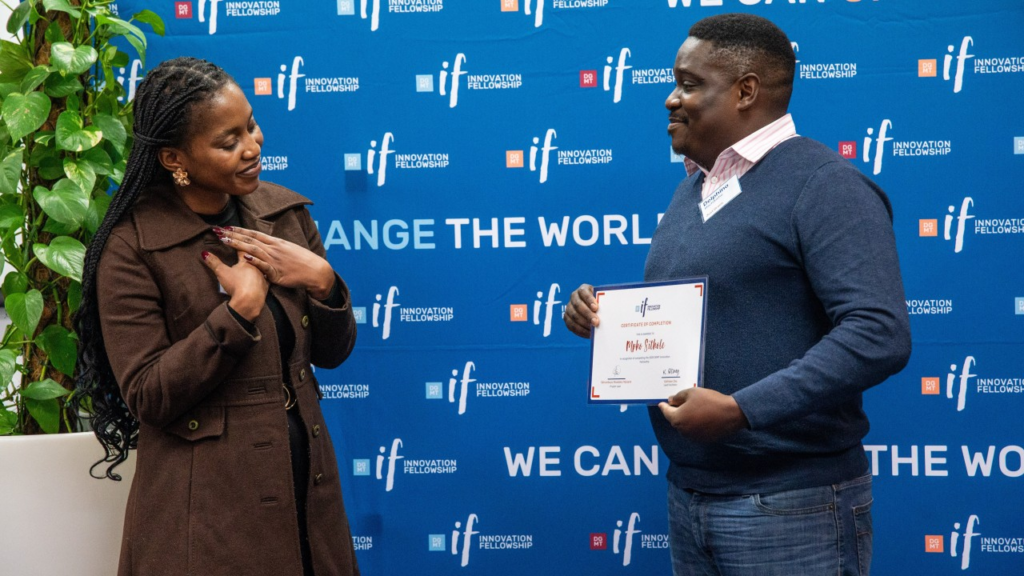
By Mpho Sithole
My name is Mpho Sithole, Business Development Manager at Just Grace NPC, an organisation that has worked to empower the community of Langa since 2012 through skills development, psychosocial support, trauma-informed counselling, and after-school support, amongst other initiatives. I had been with the organisation for almost three years when I joined the Fellowship. Honestly, I didn’t know much about it – I applied because my director asked a colleague and me to. That “out of duty” application changed me in ways I couldn’t have imagined.
I remember walking into the first immersion with deadlines ringing in my mind, trying to recharge my social battery for a week that would be spent with strangers, and struggling to recall the innovation challenge we had put down at the application stage. The first immersion focused on us as individuals. For the first time, I observed myself and my thoughts almost from the outside – not with suspicion or problem solving, but with curiosity. I watched the thinker. So much of what I believed was challenged. I went home that Friday in what felt like an existential crisis, questioning everything I thought I knew. That was the start of my unlearning.
That unlearning mattered. It allowed me to enter the sensing, envisioning, and offering phases without fixed assumptions, learning at every step. My “fellow fellow” kept me grounded, challenged my thinking, and helped me see my blind spots. I was grateful not to walk the journey alone.
Before leaving the first immersion, we set aside two hours each week to meet and reflect on the process. We blocked the time in our calendars and protected it as far as possible. If we had no choice but to miss a meeting, we made up the time later that same week. Be very intentional with every aspect of the process – the work and the resting.
The process was not easy. Many times, I caught myself allowing assumptions to get in the way. If you can, train yourself to notice when assumption is leading you, and practise stepping back from that position. It is not always easy, but talking things through with my fellow fellow strengthened that muscle and helped me recognise when I was operating from assumption during the process.
There were many moments of discomfort. Sometimes all I could do was sit in them and keep going. I remember asking our learning group leader if it would get easier (his laughter told us that it wouldn’t be). My coach helped me talk through both the discomfort and the growth and brought real clarity to so many areas I was working through. The advice I would give: be honest with your coach, and with yourself, in those sessions. That is one of the best investments you’ll make in this process.
The real shift came when I stopped seeing the Fellowship process as coming up with a solution for one organisational challenge (ours) and started seeing it as a catalyst for sectoral ones. So many of the fellows in our cohort were facing similar problems, and I realised our solutions could serve the sector, not just our own organisations. Because of the learnings during the process and wanting to not only continue them but also share them with others, we (Just Grace) incorporated some of what we learned directly into how our team works – using the Six Thinking Hats to structure how we discuss decisions, building ontological check-ins into our meetings, and talking more deliberately about the organisation as a living system rather than a fixed set of processes operating outside of each other/in silos. Becoming a better leader for Just Grace means I can help develop other leaders in our organisation who will also be better leaders across the sector – generative leadership lives in how we practise leadership daily.
My cohort became a genuine support system. My advice to current Fellows: forge real friendships (or something that resembles that) with your group. They understand exactly what you’re going through in a way few others can. Bounce ideas off each other, visit each other’s organisations if possible, and stay close – those relationships carry the learning forward once faculty is no longer there to hold you in the process. And once faculty is gone and the process ends, they’ll help keep things together.
Investing fully in the Fellowship changes how you see yourself, your colleagues, your organisation, and the sector. I am not the same person I was when I started. I hope you won’t be either. There’s a whole sector waiting for the kind of leader this Fellowship can help you become.
